
Leland Blue: History of Michigan Slag Glass
Introduction leland blue
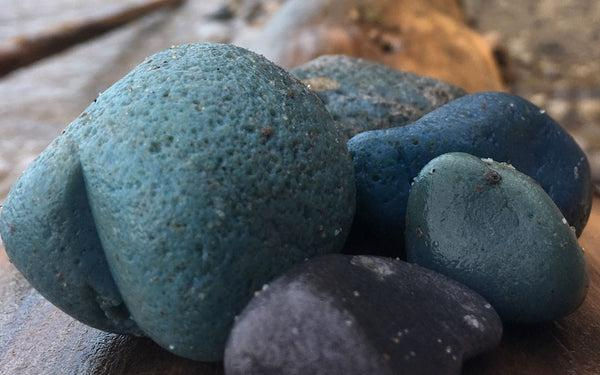
Along the shores of Lake Michigan, in the small town of Leland, it is not uncommon to come across fragments of deep blue material, sometimes translucent, often marked by bubbles frozen within the mass. At first glance, these pieces resemble natural stones, shaped and polished by water and time. Yet their origin is entirely different. Leland Blue is not a gemstone in the traditional sense, but rather the remnant of a now-defunct industrial activity. It offers a striking example of how a discarded material can, over decades, acquire new aesthetic and cultural value.

A Brief but Significant Industrial Origin
The story of Leland Blue begins in the late 19th century, during a period of rapid industrial development around the Great Lakes. In 1870, a blast furnace was established in Leland to process iron ore sourced from Michigan’s Upper Peninsula. The operation relied on locally produced charcoal and a still-developing logistical network dependent on lake transport. Despite a promising start, the venture quickly encountered major economic and technical challenges. High operating costs, combined with transportation difficulties, ultimately led to the site’s closure in 1885, after just fifteen years of activity. (Source: fishtownmi.org)

The Formation of Slag Glass
Leland Blue is a direct byproduct of the metallurgical process used to produce iron. During smelting, limestone was added as a flux to capture impurities. These impurities combined to form a separate molten phase known as slag. Once removed from the metal, this molten slag was discarded and cooled rapidly upon contact with air or water. This abrupt cooling prevented the formation of a crystalline structure, resulting instead in an amorphous material: industrial glass. Though considered worthless by operators at the time, this material is the very foundation of what we now call Leland Blue. (Source: fishtownmi.org)
From Industrial Waste to Natural Transformation
By the late 19th century, these slag residues were simply discarded into the environment, often directly into Lake Michigan or nearby areas. This commonplace practice would ultimately shape the material’s future. Through the combined effects of wave action, temperature fluctuations, and mechanical erosion, the slag fragments were gradually broken down, transported, and naturally polished. Over decades, they returned to the shoreline as smooth, rounded pebbles, transforming industrial waste into collectible objects. This slow process gives Leland Blue its distinctive natural patina, which plays a key role in its current appeal. (Source: fishtownmi.org)
A Gemmological Perspective
From a gemmological standpoint, Leland Blue is characterized by its glassy nature and amorphous structure. Unlike crystalline minerals, it lacks an ordered internal arrangement, which explains the absence of cleavage and its particular optical behavior. The frequent presence of bubbles, sometimes varying in size, reflects gas release during cooling. Color variations, ranging from deep blue to gray, green, or even purple, are linked to the chemical composition of the slag, notably the presence of iron, sulfur, and trace metallic elements. This internal heterogeneity gives each fragment a unique visual identity, comparable to certain archaeological glasses or vitrified slags.

A Material Reclaimed by Lapidary Work
What defines Leland Blue beyond its composition is its shift in status. Once regarded as mere waste, it has gradually been collected by locals and visitors, drawn to its color and texture. Today, it is used in artisan jewelry, particularly as cabochons, as well as in decorative objects. Lapidary work reveals translucent zones, enhances internal contrasts, and highlights the material’s characteristic bubbles. Each finished piece becomes a unique interpretation of what was once a standardized industrial byproduct.

A Strong Territorial Marker
Leland Blue is deeply tied to its place of origin. Its distribution remains largely local, confined to the beaches around Leland, reinforcing both its identity and symbolic value. It stands as a tangible testimony to Michigan’s industrial past, representing a brief yet intense period of resource exploitation. In this sense, it can be viewed as both a geological and anthropogenic archive, where natural processes and human activity intersect.

Conclusion
Leland Blue offers a compelling illustration of how materials evolve at the intersection of industry, environment, and human perception. Born from a technical process, discarded as waste, and later rediscovered and valued, it has undergone multiple transformations over time. It reminds us that the concept of a gem is not limited to natural origin alone, but also encompasses aesthetics, rarity, and the story a material carries. In this respect, Leland Blue stands as a unique example of a “long-time gem,” shaped as much by human activity as by natural forces.


Comments